
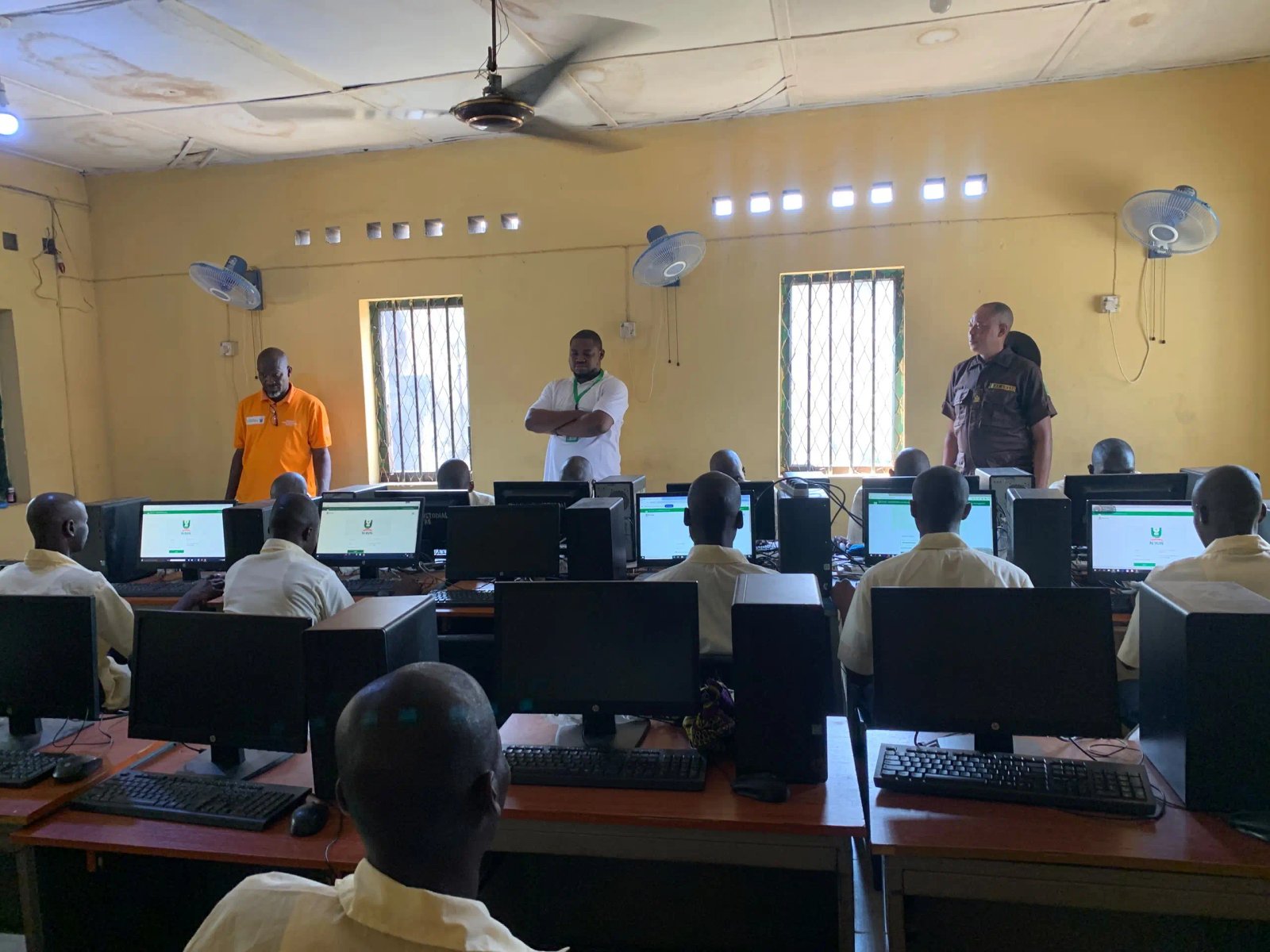
No fewer than 218 inmates across custodial centres in Ogun State on Wednesday sat for the ongoing National Examinations Council, NECO, and National Open University of Nigeria, NOUN, computer-based examinations.
DAILY POST reports that the examinations are part of efforts to promote education, rehabilitation and reintegration of inmates into society.
Speaking during the examinations, the Superintendent of Corrections and Social Welfare/Education Officer, SP Awesu Abdulhakeem, said 156 inmates registered for the NECO examination across the state.
Giving a breakdown, Abdulhakeem said 81 inmates were from the Old Abeokuta, Ibara centre, 16 from the New Abeokuta, Oba centre, 14 from Ilaro, 25 from Ijebu-Ode and 20 from the Postal Training Institution, Adigbe.
He added that 62 inmates were also sitting for the NOUN e-examination, which commenced on Wednesday, bringing the total number of candidates to 218.
He explained that the Nigeria Correctional Service no longer focuses on punishment but on correction.
“When you come to the custodial centres, it is no longer punitive, rather it is for corrections, just as the name denotes, Nigeria Correctional Service,” he said.
“We focus majorly on the correction aspect of our inmates, that all inmates should undergo a functional educational programme so that when they go out, they become useful to themselves and the society at large.”
Abdulhakeem disclosed that the programme was sustained with support from the state government, NGOs, religious bodies and individuals, who pay for the inmates’ NECO registration following recommendations based on good conduct and eligibility.
He also advised the inmates to prepare for life after incarceration and stay away from crime, urging them not to relent in their efforts to prepare for their reintegration into society.
Also speaking, the Public Relations Officer of the Nigeria Correctional Service, Ogun State Command, CSC Odukoya Olayinka, said the mandate of the Service was to ensure that inmates were rehabilitated, reformed and reintegrated into society.
According to him, the training was not limited to education but also included vocational, theological and computer training.
“When you train the mind, you are able to build a better society. You can see the way they are handling it, it tells us that they are not the same persons that came into the facility. They are already becoming something different, becoming a better person that society wants them to be,” he said.
Olayinka also urged members of the public to stop stigmatising former inmates, stressing that they deserved second chances.
“If we have them here and they believe they have come, they have seen and have conquered, they have changed their ways, they are ready to become a better person in society and we are not embracing them, we are returning them back to their old world, then we are not helping them.”
A teacher and examination supervisor, Mrs Adetutu Adekanajo, said the examinations were aimed at enlightening inmates, broadening their knowledge and making them feel part of society.
Adekanajo said there was no difference between what she observed at the custodial centre and what obtained outside, urging inmates to pursue education after leaving the facility. She also advised members of the public not to regard imprisonment as the end of life.
“Honestly, when I was told I’m coming to Ibara Correctional Centre, I was not expecting it to be this peaceful, because I felt you’re going to go and meet prisoners the way they will act and all that, but seeing them, I don’t even see them as prisoners, I see them as normal candidates outside,” Adekanajo said.
